
The AI Paradox: Voice of the Customer and the Listening Layer of AI
What if the missing layer in AI scalability isn’t technical, but human? The Listening Layer turns experience into learning.


Many AI projects struggle to scale for reasons that extend beyond the model. One is the organisation’s failure to learn systematically from the people using them.
CX for AI · Season 2 · S02A02
The current wave of generative AI has created a strange paradox inside many organisations.
AI adoption is often treated as a technology project. The real challenge, however, is infrastructural: building the system that allows organisations to learn from real interactions.
The more companies automate interactions with AI, the less they seem to listen to the people using it — one of the hidden reasons many AI initiatives struggle to scale.
Across industries, organisations have rushed to experiment with assistants, copilots and automated answers powered by large language models (LLMs).
Yet research from organisations such as MIT Sloan, McKinsey, Stanford and Gartner points to a recurring pattern: many companies experiment with AI, but only a minority succeed in scaling these initiatives into everyday operations.
The model is only part of the problem. Often, the organisation simply does not learn fast enough.
In previous articles in the CX for AI series, we explored how trust, confidence, inclusion and clarity shape the way people experience intelligent systems. In Season Two, the question shifts: if trust is no longer just a feeling but a system property, what infrastructure allows organisations to learn fast enough from real AI interactions?
The Myth: AI Automatically Creates Insight
A common assumption in the current AI wave is that AI systems naturally generate insight about users. Modern AI systems produce an enormous volume of signals:
- prompts and questions
- conversation logs
- usage analytics
- interaction patterns.
But data alone is not insight. Without a structured way to interpret these signals, organisations accumulate data without learning.
This is where an older discipline becomes unexpectedly critical: Voice of the Customer (VoC).
AI Systems Improve Through Experience Signals
Traditional software products improve through periodic releases. AI systems improve through continuous feedback loops.
Every interaction generates signals about how people experience the system:
- when users reformulate their question
- when they verify the answer elsewhere
- when they repeat the same question
- when they abandon the interaction entirely.
These are not technical metrics. They are experience signals.
Without capturing and interpreting them, organisations cannot distinguish between:
- a correct answer
- an untrusted answer
- an answer that creates confusion.
In other words, the performance of an AI system depends not only on model quality, but on the organisation’s ability to listen.
This is where the paradox of AI becomes visible.
“Organisations invest millions in models and infrastructure — yet often overlook the simplest mechanism that allows intelligent systems to improve: listening.” — Sheila Maceira
FIELD INSIGHT — When AI Performance Is Not the Real Problem
During a conversational AI transformation in an insurance service environment, early metrics looked strong: intent recognition rates were high and automation levels promising. Yet customer satisfaction did not improve. Interaction data revealed a different signal: customers repeatedly reformulated the same question. Technically the assistant had answered. Experientially, the answer did not inspire trust. Once these signals were incorporated into the improvement cycle — clarifying responses, improving explanations and escalation paths — the system improved rapidly. Outcome: customer satisfaction increased and repeated queries declined significantly. The model had not changed. The listening loop had.
The Forgotten Infrastructure: Voice of the Customer
Voice of the Customer programmes were originally designed to capture customer insight across channels:
- surveys
- support interactions
- user research
- behavioural analytics.
In the era of AI, Voice of the Customer is no longer only about understanding customers. It becomes the learning infrastructure of intelligent systems.
A mature VoC capability connects signals that would otherwise remain fragmented:
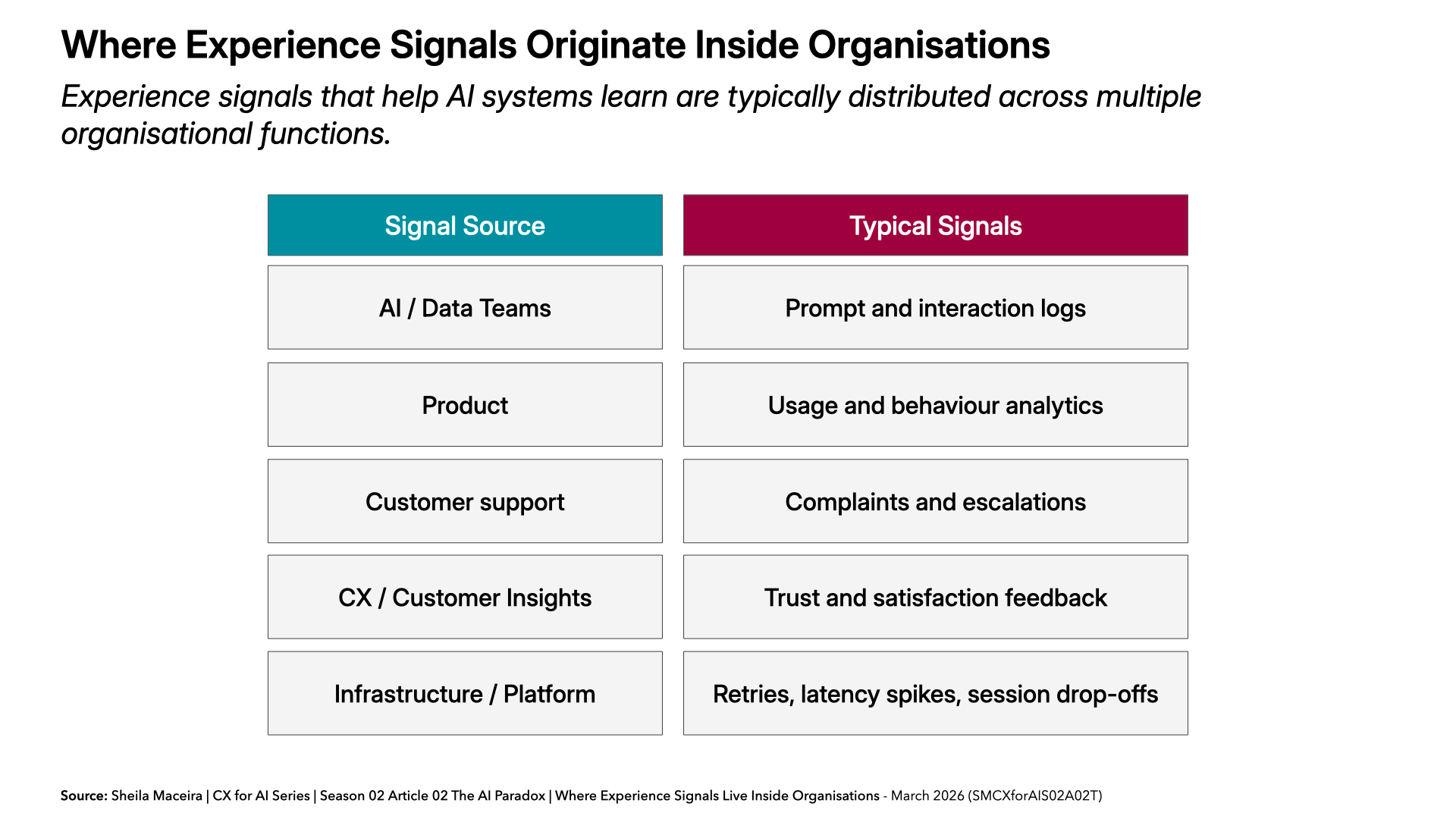
Learning requires integrating signals across functions. When these signals remain siloed, AI systems stagnate. When they are connected, organisations gain something more valuable than model performance: learning velocity.
In the CX for AI series, we refer to this organisational capability as the Listening Layer of AI.
FIELD INSIGHT — Adoption Signals Are Experience Signals
In a banking environment, an internal AI assistant was introduced to help employees navigate complex internal knowledge. Early usage looked promising, but adoption quickly plateaued. Experience signals revealed the issue: employees hesitated when the assistant sounded confident but showed no sources or uncertainty. Once responses surfaced confidence levels and references, trust increased. Outcome: adoption grew significantly, internal NPS improved, and contact centre queries decreased as employees relied more on the assistant. Again, the model had not changed. The listening loop had.
This capability is also central to Responsible AI governance.
Many governance frameworks focus on principles, risk assessments, and model oversight. Yet responsible systems require detecting when users experience confusion, hesitation, or misplaced confidence.
Voice of the Customer provides this signal layer — helping organisations detect when an AI system is technically correct but experientially misleading — and intervene before small issues become systemic risks.
The Listening Layer Behind Successful AI Systems
Behind every successful AI deployment lies a simple mechanism, often invisible: a listening loop.
In practice, these signals rarely live in one place. They are distributed across product, CX, support, infrastructure and AI teams — which is why many organisations struggle to learn from them.
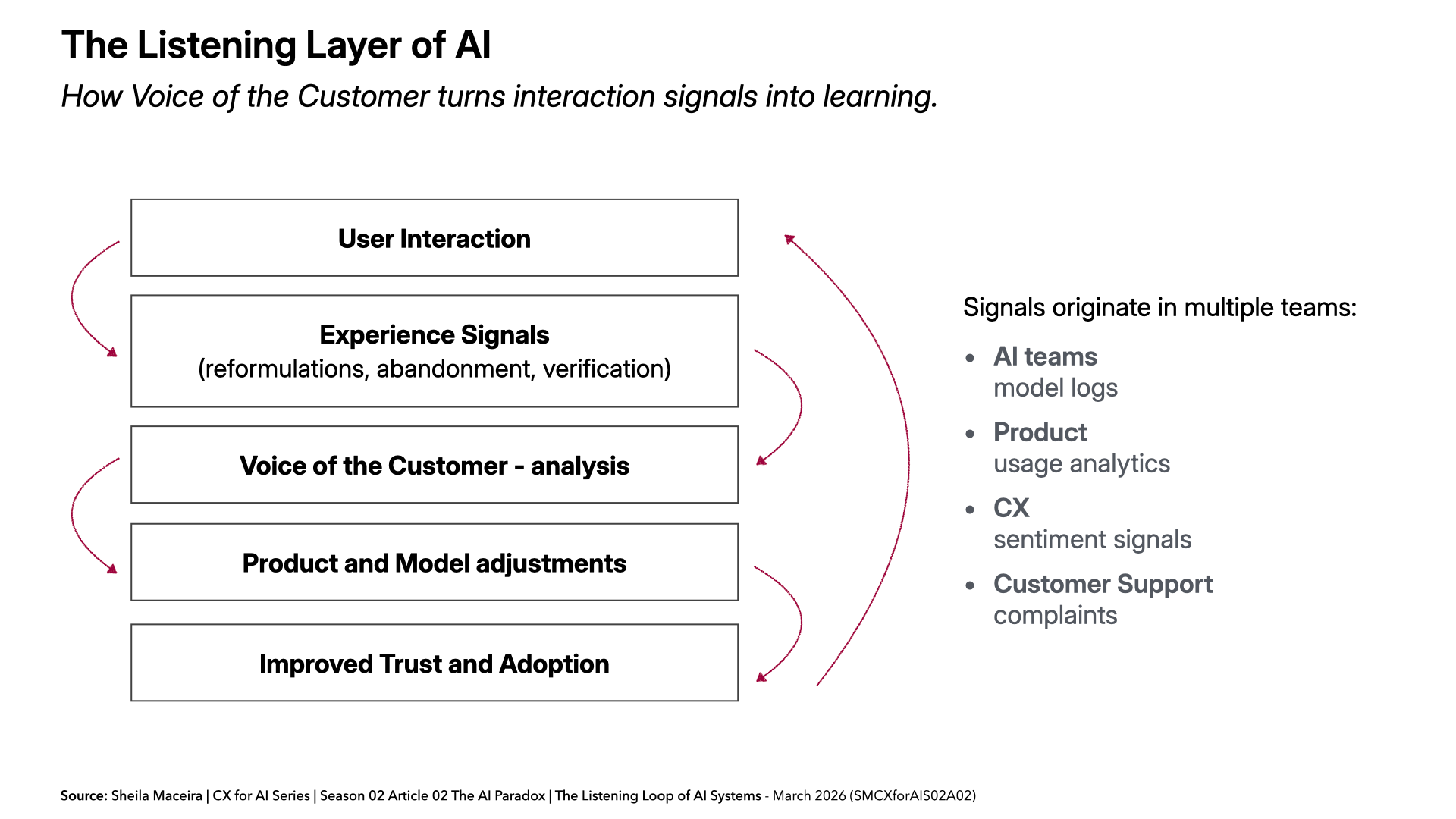
Organisations that scale AI successfully build this loop deliberately. Those that struggle often skip it: they optimise the model but never fully understand the experience.
What This Means for Organisations
As AI systems move from experimentation to operational deployment, Voice of the Customer becomes a strategic capability.
Not simply for understanding customers. But for enabling AI systems to learn safely and effectively in real environments.
This requires new collaboration between functions that historically operated separately:
- AI and data teams
- product organisations
- CX and customer insight teams
- governance and risk functions.
Responsible AI is not only about compliance, it is also about organisational learning.
Conclusion: The AI Paradox
The more organisations automate interactions with AI, the more important listening becomes.
AI systems do not improve through data alone. They improve when organisations learn from experience—and experience lives in the Voice of the Customer.
In the age of AI, intelligence improves not only through better models, but through better listening.
Publication note: This essay is part of CX for AI, a series exploring the infrastructure of trust, demand and growth in AI-mediated markets. It was first published on Medium in March 2026.